Why does no one headline: "AfD result in Offenbach HALVED"?
Volksverpetzer
The coverage of the AfD focuses on its successes, while its defeats are hardly noticed. But why are the actual weaknesses, such as internal conflicts and low list strength, systematically concealed? A distorted picture could significantly influence the political reality.
Why isn't this in the headlines: In Offenbach am Main, the AfD has HALVED its result. If "AfD strongest party!" immediately appears when they are narrowly leading with 25% in a constituency*, why are their defeats being concealed? Why is it only news when the AfD wins?
In Offenbach halved
The AfD's result in Offenbach has halved; in only one-fifth of all municipalities the far-right extremists even appeared on the ballot. Compared to 2016, the AfD has only minimally gained. While in Büdingen, with 25.36 percent of the votes, narrowly holds the first place, the media headline "Landslide" and "AfD victory". The right-wing flop in Offenbach receives no attention at all. There, the AfD got 3.5% – a decrease of 3.8 percentage points.
Of course, the story in Offenbach isn't so simple: The AfD didn't lose (only) because voters punished it. The far-right extremists themselves disbanded. The former chairwoman of the Offenbach AfD association, Christin Thüne, has been openly in conflict with the Hessian state leadership for some time. In October 2025, they dismissed the entire Offenbach party leadership. Thüne, who is associated with the far-right wing and in 2021 invited fascist Björn Höcke to Offenbach, is now even accused of embezzling party funds.
The candidate list for the local elections was ultimately only created through a provisional leadership, where nine state board members were present, but no one from Thüne's camp, after 19 members temporarily lost their membership rights and thus the right to run for office. The AfD has disintegrated itself in Offenbach, thereby losing its own voters' support.
AfD only ran in one-fifth of all municipalities!
In Offenbach, far fewer candidates were on the list than could have been, and therefore many potential votes "puffed away." But this is not an isolated case. Focusing specifically on the defeats: In Offenbach, the AfD achieved around 3.5% with only seven candidates, in Mörfelden-Walldorf at 2.7% with three candidates, in Ebach with just two candidates and 3.7%, and similar in Langenselbold, Nidderau and Bad König.
Those who know the numbers see a picture that sharply contradicts the usual narratives about the supposedly unstoppable party. Political scientist Dorothée de Nève pointed out that the AfD was only on the ballot in one-fifth of Hessian municipalities. There is a simple reason for this: the party has only about 4,600 members across Hesse, of whom an estimated ten percent are active. This thin personnel base simply isn't enough for a comprehensive local election campaign. Where they participated, the candidate lists were often so short that the party missed out on additional mandates.
Yes, these poor results are not primarily an expression of voter will but a symptom of organizational weakness. Those who do not field enough candidates do not garner votes because supporters simply have no opportunity to cast their cross. A party that cannot field enough candidates because it lacks personnel or is deeply divided is also misleadingly portrayed as a confident winner on the verge of seizing power. But this personnel weakness is real. It contradicts the narrative of "We are the people." But it is not reported that way.
Even in larger cities, where the AfD submitted complete lists at least, it remained below average: In Marburg 7.75%, in Gießen 7.66%, in Darmstadt 9.05%, and in Frankfurt around 9.1% according to trend polls.
The (apparent) success compared to 2016
And another context worth mentioning, which is often overlooked in current reporting. When today it is said that the AfD has "doubled" its result, it refers to 2021, when the party was at a low point and experienced one of its worst election results ever.
Looking back to 2016, the AfD was at 13.2% across Hesse, in some districts already reaching up to 22%, while the NPD even achieved up to 17% in some areas. From this starting point, the current "surge" is much less spectacular than many headlines suggest.
Why does no one headline "AfD in Offenbach halved"? Well, there is a good explanation: the tiny list and internal disputes. But that doesn't make the election defeat any less real, does it? The "AfD victory" in, for example, Büdingen is also real – even if it gives a false impression, since the AfD only received 25.4% and just narrowly won. Büdingen is not a "AfD stronghold" if nearly 75% did not vote for the far-right extremists.
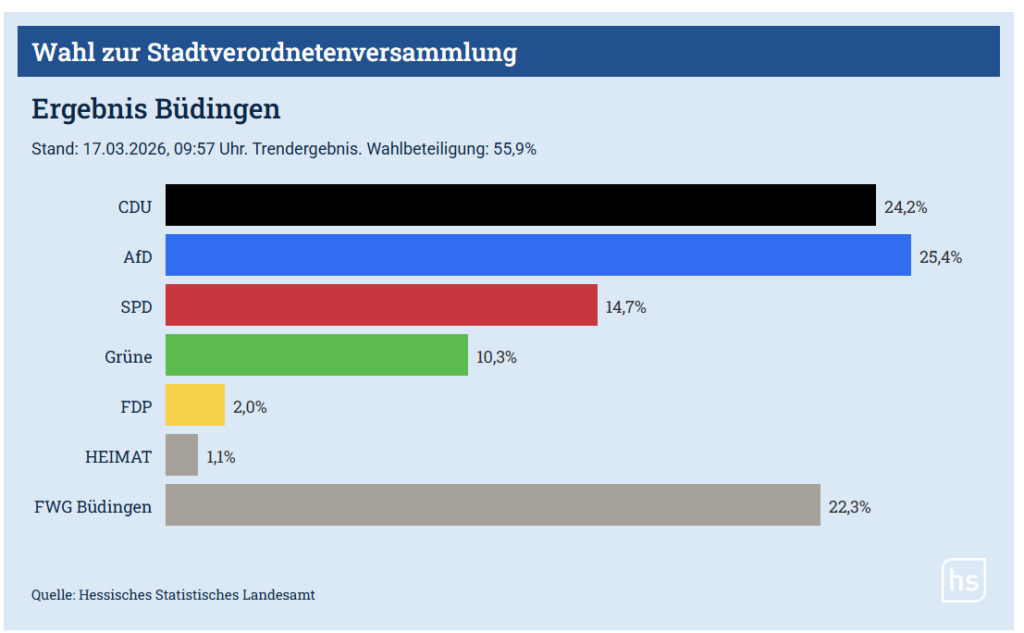
Both representations would be misleading in their own way if you only read the headlines and do not know the context.
UPDATE 18.3.: Preliminary final result. Büdingen NO LONGER an AfD victory!
Update from 18.3. 8:00: The preliminary official result shows even more our criticism of prematurely titling "AfD victories." Because in the end, that victory was not "real" – during the count, the CDU clearly overtook the far-right extremists. The AfD even fell to third place. The narrow "victory" in the trend, which was widely reported, was not one at all. But no one notices this. The news of the "AfD victory" is out there.
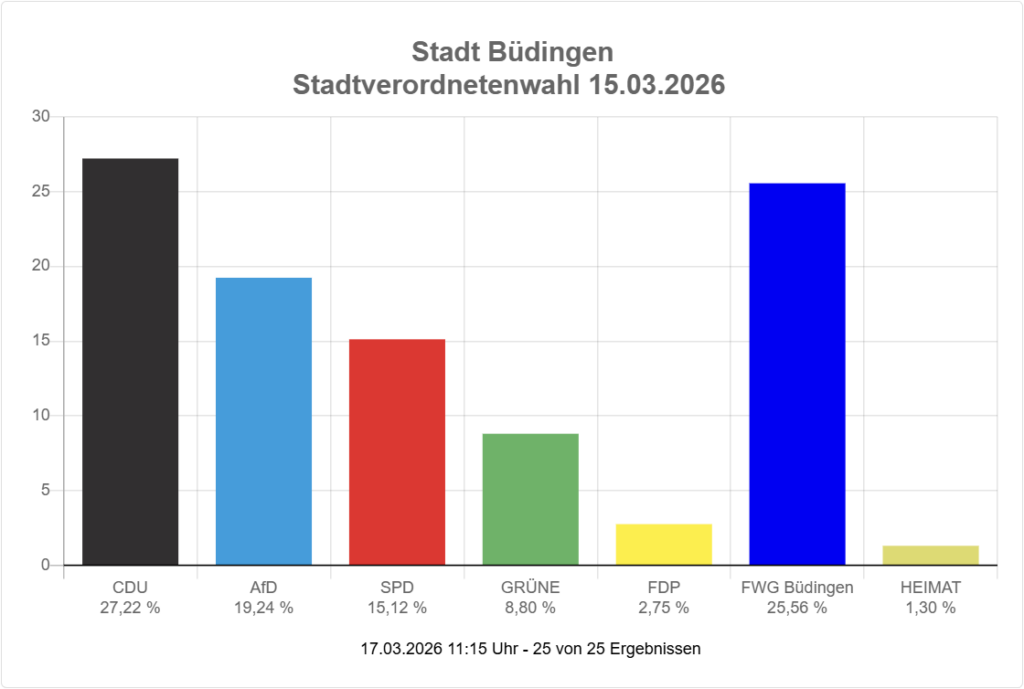
But we will stay with the update: We mentioned the comparison to the much smaller increase of the AfD result compared to 2016, but comparisons with state elections 2023 (18.4%) and federal elections 2025 (17.8%) also show relative losses compared to the current local election: AfD: 15.9%.
How did the media report on the AfD results in the Hessen election?
All of this clearly has a significant influence on the results of the local elections in Hessen. Disappointed voters who cannot give their votes to their party, lost votes: that would at least be a few headlines, right?
Not when you look at the coverage on election night and the following day. Whether hessenschau, Frankfurter Allgemeine Zeitung, Deutschlandfunk, Oberhessische Presse – everywhere headlines with AfD references focus on their strength: "Milestone", "Establishment", "Electoral success", "Victories", "Strongholds", "AfD satisfied". It is hard to criticize the editorial offices for such headlines. They generate clicks and are a true part of the results – but only a part! Even if you explicitly look for reports on the lost votes of the AfD, you will find hardly any headlines about it.
The victories are sensationalized, the defeats hidden
Writing about the weaknesses of the AfD at the local level is occasional. The interview with political scientist Dorothée de Néve by hessenschau deals among other things exactly with what limits the successes of the AfD. The title "Winners, losers, and what the trend result means" is completely meaningless; the lost AfD votes are only mentioned in the third sentence of the teaser. Shouldn't "AfD" be a good trigger word for Google searches? Also in the "5 trends in the local elections": The right analysis, hidden in second place of a generally titled list.
Other media also write about the weaknesses of the AfD, but from the headlines, this is hardly discernible. "Expert: Local political profile of the AfD remains to be seen" titles Die Zeit over a dpa report, which also discusses frustrated voters. Wouldn't that have been a headline worth it?
The Frankfurter Rundschau at least highlights that during the count, it titled "Results of the Hessen local elections in motion – AfD loses strongholds". But even here, there is no headline about the votes lost.

Ironically, the right-wing fake news blog Apollo News temporarily promoted its election ticker with the too-short AfD lists, which had cost them votes, but that didn't last long.
The AfD is elected, but no one wants to get involved for it
It's also not that the short lists didn't catch the attention of local journalists. Before the election there was coverage about it, even in regions where the AfD did not run, it was written about. Only with the election results, for which this information is extremely relevant, does it seem no longer to be headline-worthy.
There appears to be a systematic undervaluation of the fact that the AfD, although achieving high election results, simply does not have the structures to meet expectations. Because its supporters vote for it but do not want to engage politically for it.
Where it is discussed in the media, it is only touched upon tangentially and not titled as such. n-tv even references in a dpa report that the Statistical State Office publishes figures on the largest and smallest statewide vote shares of certain parties – then only mentions the municipalities with the strongest AfD results.
AfD successes get more clicks
"Milestone", "Establishment", "Electoral success", "Victories" is the vocabulary that sets the tone. It is hard to criticize the media for such headlines. They generate clicks and reflect a part of the results. But only a part. The fact that the AfD systematically wastes votes because it cannot field enough candidates is only mentioned in passing and never headline-worthy. It is always mentioned, but somewhere under "5 trends in the Hessen local elections" or at the end of articles. The fact that it was once almost as strong – ten years ago! – is almost completely forgotten. This is not a failure of a single editorial team; it is a pattern that, in its totality, reinforces a narrative. A false one.
Behind this mainly lies a well-studied psychological effect: the negativity bias. Threatening, bad, dangerous things attract attention – and the AfD as a growing far-right force is a real threat that deserves attention. This is reflected in many aspects – studies even show that ZDF reports much more about stock market crashes than about rises.
The narrative of the AfD victory is one-sided
The problem is not that reports about AfD successes are made. The problem is that the coverage is so one-sided that a systematically distorted picture emerges. Headlines – which almost only influence perception – that focus almost exclusively on the AfD victories and ignore its structural weaknesses, unintentionally helping the AfD. They reinforce the narrative of inevitability. And a narrative that makes people believe that nothing can be done against the AfD is the most toxic campaign tool a party can have. The AfD also wants this to be true. It even tells it itself!
But other aspects must not be overlooked. It is not about denying the real gains of the AfD. They are real. The danger of rising fascism is real. But that does not mean it will necessarily come. Scaremongering is not a sober analysis. Those paralyzed by fear are unable to defend themselves. And importantly: it is not too late. Now is still the opportunity to prevent the rise of the AfD. And it is crucial to see that they are neither unstoppable nor invincible.
Because what is the AfD in reality? It is supported by the most powerful people and states of the world, supported by the wealthiest, by many billionaires. It receives a lot of attention and media power. A new analysis shows that the majority of pro-AfD posts on TikTok, for example, originate from Nigeria.
The false giant AfD
But when it comes down to it, in municipalities and cities, it has enormous problems finding people to run for it. And still, when it matters, it has huge problems in municipalities and cities to find enough people willing to stand for it. In the recent Bavarian local elections, it was hardly different: In only 47 municipalities with more than 10,000 inhabitants, the AfD nominated a candidate for mayor. In Erlangen, it had such poor personnel that it fielded four convicted individuals and at least eight people with legal issues. In the end, they even lost a seat to the Greens.
This fundamentally contradicts the narrative of "We are the people." A party that claims to have the people's support should have no trouble finding a handful of candidates in every municipality. The vast majority of Germans are against the AfD. One can hardly imagine how great the rejection is – precisely because it is not so much in the spotlight.
The "people" are against the AfD
Two of the largest protest waves in the history of the Federal Republic were directed directly against right-wing extremism and this party – the anti-right protests of 2024 and 2025, with 2024, which was by far the largest wave of protests ever! These people are not gone. These protests have shown their effect. They slowed down the AfD. And in polls, the party has been stagnating again for a year. That is no coincidence; it proves that societal resistance also works.
The question is not whether the AfD can be stopped. The question is whether we let ourselves be intimidated by a media image that only shows its strengths and ignores its weaknesses. The AfD can only win if we let it. Its victory is not a given, on the contrary. We must not forget that. We also need to understand and communicate that. The AfD speaks very confidently about its destiny to seize power. Not because it is true, but because it helps them if enough people believe it and give up. We must not allow that. It is important to understand why they do lose after all. And learn from it.
Article image: Igor Link, shutterstock.com Parts of the article were created with machine assistance. As Volksverpetzer AI uses.