Rhineland-Palatinate: They wanted to take over the village – then THIS happened!
Volksverpetzer
Before the state election in Rhineland-Palatinate, the far-right presence is growing in rural areas. With new meeting places and strategic networking, the AfD is trying to conquer social spaces – but committed democrats are under pressure to defend their spaces. How can democratic resistance endure?
This article by Luisa Gerdsmeyer was first published on Belltower News
Before the state election on March 22, 2026, the AfD gains support in Rhineland-Palatinate – and increases its presence in rural areas. With new meeting points and strategic networking, it tries to establish itself permanently. But resistance is forming in many places: engaged citizens defend democratic spaces – often under growing pressure.
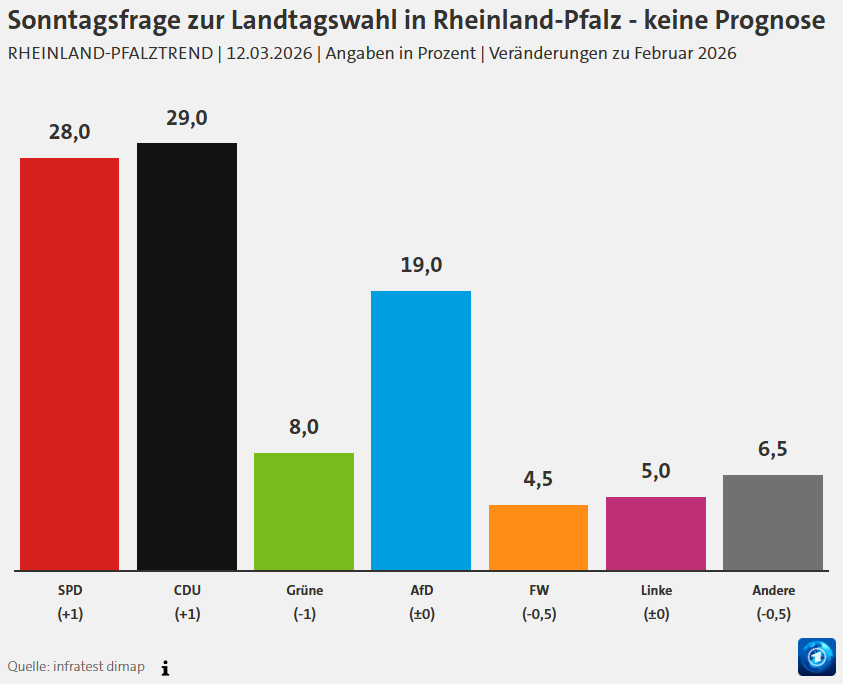
On March 22, 2026, Rhineland-Palatinate will elect a new state parliament. While the SPD and CDU compete for first place, the far-right AfD has been steadily in third place in polls for months, currently with 19 percent. This indicates the party is heading for a record result in Rhineland-Palatinate. In the last state election, it only achieved 8.3 percent.
For the AfD, Rhineland-Palatinate has particular strategic importance. The predominantly rural federal state is one of the western German regions where it aims to strengthen its foothold across the area. For the 2026 state elections in Rhineland-Palatinate and Baden-Württemberg, the party has established a so-called “Taskforce Southwest” and intends to transfer its successes in the southwest to other western German states. The increasing importance of the state is also reflected in the presence of nationwide AfD top personnel campaigning in Rhineland-Palatinate. Especially in structurally weak areas, the far-right party tries to fill societal gaps and create its own offerings – often where there are only a few places where people can come together.
Space occupation as strategy: The “Meeting Point North Palatinate” in Gauersheim
How the AfD attempts to establish such spaces can be observed in Gauersheim, a small village in the Donnersberg district. There, the party opened in July 2025 its “Meeting Point North Palatinate,” a venue for events and networking. The meeting point is rented and operated by local Rhineland-Palatinate AfD politicians. Of significance for the project and the strategy of space occupation in rural areas is a network around the Rhineland-Palatinate Bundestag member Sebastian Münzenmaier. The goal: to be present as a party in rural areas, create contact points, and embed the AfD across the region. Similar centers are also planned in the areas of Kaiserslautern, Kusel, and Birkenfeld.
In Gauersheim, it is also observable how intimidating such a presence can be. When the AfD invited to a citizens’ dialogue at their meeting point in October 2025, engaged citizens organized an alternative discussion event on the marketplace to shape and maintain democratic spaces locally. When the AfD representatives and supporters arrived, the engaged citizens were harassed, filmed, and sometimes physically attacked by them. A woman reports that it felt like “a real invasion” as AfD supporters with German flags marched through the small town. The mayor describes an tense situation in the village since the incident. Some residents are afraid to leave their homes when AfD events take place in Gauersheim.
Connections to the far-right extremist milieu
Experts and engaged citizens observe a close interconnection of the AfD with far-right extremist organizations. Figures from the extreme right spectrum appear in the election campaign – for example, the Dortmund AfD politician Matthias Helferich, against whom a party exclusion procedure is underway due to statements of neo-Nazi ideology, or the far-right singer Julia Juls, who performed on stage at an AfD campaign event.
Also, neo-Nazi structures like the “III. Weg” or youth groups of the “Young Nationalists” (youth organization of the party “Die Heimat”) are gaining followers in Rhineland-Palatinate. Much of this is not a new development – but the increasing support for far-right parties shifts societal attitudes and enlarges the scope of action for these groups.
When volunteer work is politically attacked
For engaged citizens in Rhineland-Palatinate, these developments are clearly felt. Intimidation and assaults are increasing. Two examples from recent months: At the Christmas market in Zweibrücken, engaged citizens at the “Grandmothers Against Right-Wing Extremism” stand were attacked with AfD merchandise, and the stand was covered with far-right stickers. Musicians from the Palatinate band “Anonyme Giddarischde,” who performed at a demonstration against an AfD campaign event, faced massive hostility and announced they would temporarily withdraw from political engagement.
At the same time, new counter-movements are forming, and democratic alliances are being strengthened. Many engaged citizens report that more people are coming together, networking, and defending democratic spaces where far-right ideologies have no place.
Long-standing structures in the Westerwald
In northeastern Rhineland-Palatinate lies the Westerwald – a region where far-right structures have been rooted for decades. The organization Demos e.V. is active here, conducting research on far-right structures, political education, and supporting people who want to promote democratic values in their communities.
“There is a long tradition of far-right organization in the Westerwald,” says Jana from the Demos e.V. team. “In the early 2000s, the ‘Kameradschaft Westerwald’ was active here, a very violent neo-Nazi group closely linked to the NPD. After its dissolution in 2005, things quieted down – until 2015, when a new wave of far-right mobilization started in the region.” Under the title “Confession of Germany,” a former AfD member organized a series of far-right and racist demonstrations in 2015, which quickly attracted large numbers of participants – even in small villages.
Included were militant far-right groups like the “III. Weg” and individuals from the former environment of the “Kameradschaft Westerwald.” Although a broad civil society protest formed, it was not permanently stable. In response, the organization Demos was founded in 2016. “The lessons from the past years for us were that it takes actors who are active long-term and sustainably on site, build stable democratic alliances, and conduct research and educational work. That’s what we set as our goal,” says Jana.
Major raid over a neo-Nazi combat sports event
One of the greatest successes of engaged citizens in the Westerwald was the resistance against the “Fassfabrik” in Hachenburg, a far-right center opened in 2019. The building was rented by far-right extremists, served as a venue for the AfD, the “III. Weg,” and other groups, and was intended to be a “lighthouse project” of the scene in West Germany.
Demos e.V. documented activities around the center from the beginning and launched a broad campaign together with local initiatives, cultural institutions, local politics, and businesses. In early 2024, they published the Hachenburg Declaration, which clearly opposed the far-right presence locally.
“After a major raid against a neo-Nazi combat sports event at the ‘Fassfabrik,’ we finally achieved a huge success at the end of 2024,” says Jana. “A group of investors bought the building, on the condition that all tenants must move out. That marked the end of the ‘lighthouse project’ of the Nazis in the Westerwald.”
After the Fassfabrik incident, the AfD had to reorganize itself in the Westerwald. Since then, it has been operating with new personnel and increasingly aggressive strategies – still closely networked with far-right actors, including leaders of the former Revolt Rhineland, a successor organization of the Identitarian Movement. “We expect the AfD to significantly increase its vote share,” says Jana. “And we already notice that hostility against us is increasing with this strength.”
Since September 2025, the AfD has submitted eight small inquiries to the Rhineland-Palatinate state parliament, linking the organization Demos e.V. with “left-wing extremism” and alleged violence, discrediting its work or questioning its funding. At the same time, far-right YouTubers have traveled to the Westerwald to specifically discredit the organization. They produced a defamatory video, attempted to obtain private information about engaged citizens through anonymous calls, and appeared at employers’ offices to film defamatory interviews about those affected.
“We have been facing attacks on our work for years,” says Jana. “But currently, it’s becoming more intense.” According to Demos e.V., the AfD is running a particularly aggressive election campaign in the region. The fact that the closing rally of the campaign is planned to take place in the Westerwald shows the engaged citizens: the region is considered a key area by the AfD, both because of its rural character and due to historically established networks among various far-right actors.
Despite all hostility, the engaged citizens also experience encouraging counter-movements. “In many small towns where far-right influence tries to take hold, people are actively standing up,” says Jana. Village communities are coming together, founding new initiatives, and organizing protests. Demos e.V. supports these groups with experience and knowledge, helping with networking and developing their own forms of action. More and more of these young initiatives are working together to defend democratic spaces and promote solidarity in the Westerwald.
Rheinhessen and North Palatinate: Youth work under pressure of justification
The far-right scene has been present for years in the Rheinhessen and North Palatinate regions, but it is becoming visibly younger, more active, and more confident. Engaged citizens observe a clear influx, especially of very young neo-Nazis.
Anne-Sophie is involved in the German Federation of Scout Associations (BDP) Rhineland-Palatinate, a youth organization that organizes political education, encounter, and participation projects. “Youth work in Rhineland-Palatinate generally faces difficulties – it is poorly funded compared to other federal states and in a precarious position,” she says. “At the same time, we are experiencing increasing mistrust when we do youth work with political aims. We are rather pessimistic that this will improve after the state elections.”
The association is currently participating in actions and demonstrations related to the state elections, working as part of the state youth council on youth political demands, and conducting formats in the Bad Kreuznach district as part of the district youth council, where young people meet with democratic politicians. Beyond the elections, they want to encourage young people to think critically, question societal conditions, and actively participate.
The normalization of far-right ideologies is felt daily by engaged citizens
Nico also volunteers with the BDP Rhineland-Palatinate and comes from Alzey. There, he founded together with classmates the OAT Alzey. Far-right actors regularly call for rallies here, mobilizing beyond regional borders. Together with other civil society groups, OAT Alzey organizes counter-demonstrations against the increasingly quarterly neo-Nazi marches in the city.
At the same time, the group is in a process of becoming more active – with political education offers and creative projects where young people can network and develop their own actions. They are also active at their schools, for example in response to a planned panel discussion on the state elections, in which the AfD is to participate. “We want to inform with flyers and conversations about the hateful ideologies the AfD promotes and how dangerous it is to give it a platform at school,” says Nico.
The normalization of far-right ideologies is felt daily by engaged citizens. Groups fighting right-wing extremism are increasingly under pressure to justify themselves. The youth center of the city, where OAT used to meet for a long time, expelled the group because it “took a political stance.” Despite these developments, Nico remains optimistic about the future: “We notice that more and more young people in Alzey want to get politically active themselves, especially because it’s about shaping their own future in the region.”
North Palatinate Mountain Range
In the North Palatinate Mountain Range around the town of Kusel, Basti is active together with the team of the “No Bock for Nazis Festival.” Every year, they organize a festival that sends a visible signal against far-right extremism in the rural region. For many who are under pressure in everyday life because of their attitude, the festival offers a place where they can network, strengthen, and find new courage.
But the group’s engagement is not limited to the festival. “The AfD district association Kusel is particularly active in Rhineland-Palatinate,” Basti explains. “We notice especially during the state election campaign that the AfD is heavily relying on this area.” At numerous campaign events in the region – including in Idar-Oberstein, where the big campaign kickoff with Alice Weidel and Tino Chrupalla took place – Basti and his comrades are present, holding rallies, info, and action stands for democratic values. At some counter-events, they are in the minority in terms of numbers. “But for us, it’s always clear that there’s no alternative but to stand here, go out on the street, and show our face,” Basti says.
Despite or because of hostility: Networking across state borders
However, their engagement comes at a high personal cost. The group experiences regular hostility; Basti himself is repeatedly insulted or shouted at in public, and stickers with defamations appear in his personal environment. Despite these hostilities, a solidarity network is currently growing in Rhineland-Palatinate. Many activists from different places support each other, travel to events of other groups, and build connections that are meant to last beyond the state elections.
Basti and his team plan a series of events around the state elections, including readings, concerts, and discussions. They want to raise awareness about the dangers of far-right extremism and develop and discuss counter-strategies together. Especially important to them is exchange with initiatives and engaged citizens from eastern German states, where the normalization of far-right ideologies is still more advanced in many places. Basti travels extensively to network and share experiences. “I find it always impressive and inspiring how much courage and perseverance people in other rural regions of Germany show, despite massive opposition, fighting on and finding creative ways to oppose right-wing extremists,” he says.
A central goal of the activists in the Kusel area is to contribute to a lively counterculture: creating spaces where people can come together, feel safe, and experience democratic coexistence – especially in a region where far-right attitudes are often trivialized or tolerated, and many are reluctant to take a clear stand.
Koblenz: Pride between solidarity and concern
In Koblenz, the Pride Koblenz team advocates for queer visibility in the city. Together with many other activists and initiatives, they participate in organizing the annual CSD and host Pride Weeks beforehand. The team consists of queer people and allies and sees its task in creating visibility and bringing people together. “Fortunately, there were hardly any direct hostility or attacks around Pride 2025,” says Marcel from the Pride Koblenz team. “But in everyday life and at individual events, we constantly notice how the mood can shift.” In the queer bar “Kurioos,” where several of our team members work, there have been increasingly frequent derogatory comments or minor attacks recently.
Regarding the state elections, the engaged citizens are not only concerned with specific election results but also with the societal shifts behind them, as Marcel emphasizes: “The acceptance of hatred against minorities is increasing, and with it, the threshold for verbal or physical violence. A stronger far-right AfD faction could further normalize this development. For our work, this would mean that queer visibility is questioned more, people become more insecure, and we have to explain more often why protection, spaces, and presence are even necessary.”
What gives hope to the engaged citizens are the strong alliances in the city and the many people supporting them. “These are often also people who may not be queer themselves but stand behind Pride very naturally. This broad support constantly shows us that queer life is not a marginal issue but an integral part of this city and Rhineland-Palatinate,” says Marcel.
Article image: Helmut Fricke/dpa. This article by Luisa Gerdsmeyer was first published on Belltower News.