Riding All the Winds
Transitions Online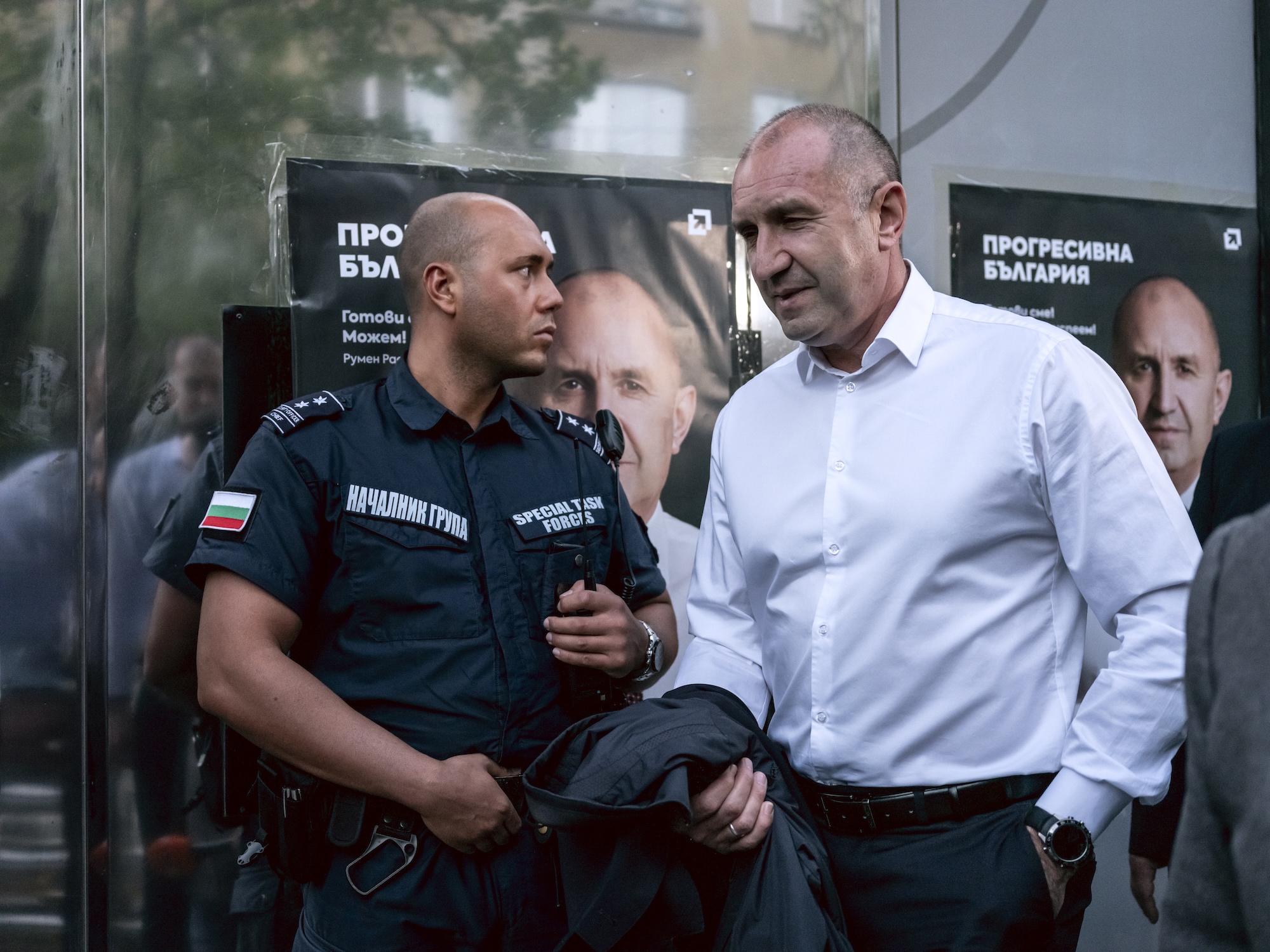
A big election win hands president-turned-premier Rumen Radev a mandate for change – but not too fast.
A big election win hands president-turned-premier Rumen Radev a mandate for change – but not too fast.
Finally, it is over. The Great Bulgarian Political Crisis, which produced eight parliamentary elections in six years – a European or perhaps a world record – ended with a landslide. A newly formed political formation will rule with a comfortable margin of 131 members in the 240-seat parliament, giving the government an absolute majority for the first time since 1997.
Blinded by the rapid motion of reality, we tend to underestimate dangers past. However, the unprecedented political turmoil of recent years could have brought much worse than administrative standstill and costly repeated elections. Political paralysis in times of global insecurity could have risked the very foundations of Bulgarian democracy. That’s why voters decided to stop it.
They did not know the winner, Progressive Bulgaria: its formal inauguration as a party was two days before the election. But they knew the person behind it very well: Rumen Radev. A year before the end of his second and final presidential term, the former air force general quit the largely ceremonial post to enter party politics and participate in the snap election. Voters chose him twice as president. Now, they’ve entrusted him with real power.
To answer why, let us go back to the roots of the crisis. In Bulgaria of the early 2020s, COVID, war in Ukraine, inflation, and social-media fragmentation coincided with an end of a long political cycle. Boyko Borissov and his center-right GERB, the most successful party of the Bulgarian transition, were embattled and entangled in accusations of corruption. The former police general, a champion vote-winner, faced his biggest challenge.
Enter Delyan Peevski. The oligarch and media magnate fought his way to the top of the Movement for Rights and Freedom, a party supported mainly by Bulgarian Turks and Muslims. Meanwhile, he was put on the U.S. Magnitsky sanctions list for “corruption,” mostly associated with influence over the judiciary, politics, and media. In 2013 huge demonstrations erupted over his appointment to head the national security agency, promptly revoked.
Peevski and Borissov were on opposite sides then. In 2020s the feeling was that they were allies. Demonstrators hit the streets – again in 2021, and yet again in the winter of 2025. A government backed by both of them fell, clearing the way for yet another early election.

All these factors complicated the long crisis.Two fronts emerged. The first centered around the issue of corruption. Here, urban center-right and liberal voters, who ultimately united in the PP-DB coalition (We Continue the Change – Democratic Bulgaria), sided with President Radev. Yet, on the other front – support for Ukraine – PP-DB were closer to Borissov and Peevski. Radev showed less enthusiasm for Ukraine, even making the ambivalent statement that “Crimea is Russian” (he clarified later that he had meant the status quo, not the rights of Ukraine to possess the peninsula).
So who should side with whom? A true math puzzler. Parties had to make unnatural pacts with the opponent to produce a majority. They tried all kinds of combinations – along the anti-corruption and along the war front. Yet, while one made unlikely partners to stick together, albeit grudgingly – the other sooner or later prompted the shaky construction to collapse. Thus, the political stalemate.
This is all history now. Rumen Radev has the majority, alone. Is it pro-Russian? Far from that. Yes, some Russophiles voted Progressive Bulgaria. Bulgarians, however, would not prefer Moscow to Brussels. Apart from NATO membership, Bulgaria is part of the EU’s core, joining Schengen in 2025 and the eurozone this year, and will not abandon it.
Radev himself does not want to – or at least this is what he says publicly. He had small disagreements – for example, whether it was better to join the eurozone now or wait until the country would be more prepared. From now on, his words will challenge the EU hierarchy in Brussels – but hardly his deeds. Observers do not expect a new Orban. They instead anticipate a careful balance between rhetoric and actions.
Maybe this is what Bulgarians voted for. Tired of political instability in a crazy world, they do not want another tilt. The shock of higher prices, which Radev attributed entirely to premature adoption of the euro, downplaying Trump’s endeavors in the Middle East, contributed to Progressive Bulgaria’s stunning victory. No more whirlwinds, please!
Gen. Borissov lured voters for years promising to ride all the geopolitical winds at once, to stick with the global winners – and to avoid a collision. Gen. Radev may have a similar idea. Perhaps, generals know the arts of Sun Tzu: winning wars without waging them.
What can stand in Radev’s way? “Events, dear boy, events,” British Prime Minister Harold Macmillan was quoted as saying when asked about the hardest challenge for a statesman. Unexpected events, from war escalation to skyrocketing prices or a scandal out of nothing, could put his balancing abilities to the test. Good thing he was trained for that as a crack pilot.
Meanwhile, he will try to keep Bulgaria in a safe harbor. Voters would love that. Tranquility is a blessing these days.
Boyko Vassilev is the moderator and producer of the weekly Panorama news talk show on Bulgarian National Television.
Latest News

A New Bosnia: The War That the World Watched
by Tihomir Loza
12 Dec 202510 Mar 2026

Why Journalism Must Shrink to Grow
by Peter Erdelyi
12 Dec 202520 Jan 2026

Bosnia, 30 Years After
by Federico Tisa
11 Dec 202511 Dec 2025

How Ukrainian Women are Turning Mourning Into Meaning
by Katarzyna Tarczynska
10 Dec 202527 Feb 2026