Come for the art, stay for the geopolitical collapse.
Kapitál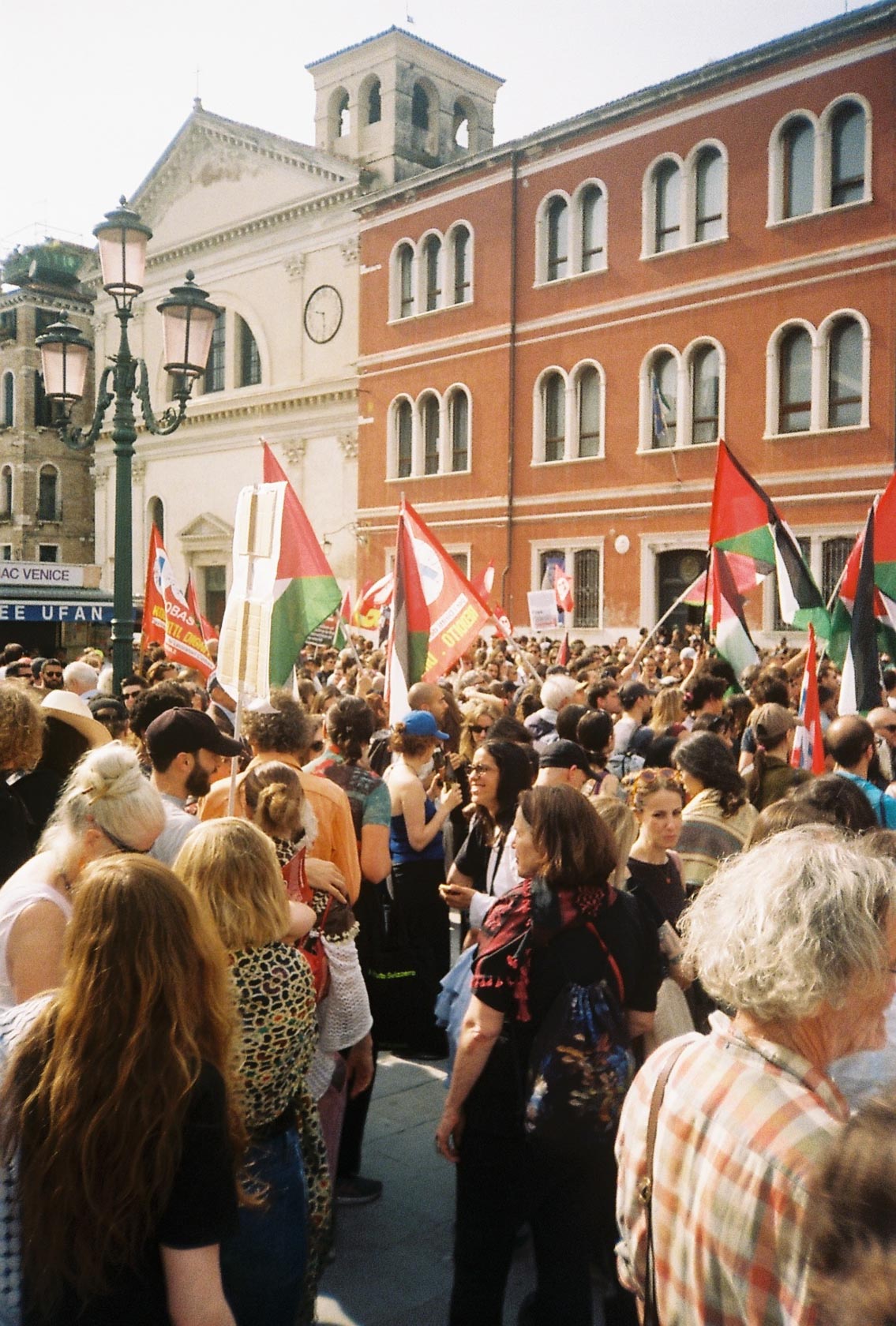
Venice Biennale reveals deep tension between art and politics, protests, and controversies. What shades does this year's geopolitical chaos have, and what signals does the global art scene send in times of worldwide conflicts?
Instagram profile Artnotnet published a witty summary of the atmosphere of the 61st edition of the international contemporary art exhibition in Venice: “Come for the art, stay for the geopolitical collapse. Resignations, canceled prizes, armed police, curatorial dramas, pet shop, discourse, Björk.” The aesthetics of this subversive meme account alludes to similar platforms – for example, Style Not Com by Georgian designer Beka Gvishiani – which deliver quick and stylized reports on current events in the art world. As if in the rapid pace of media spectacle, there is no room for a more complex commentary.
For the pre-opening of the Venice Biennale, where entry is only possible by invitation primarily intended for the global art elite, I participated for the first time. I was checking with a friend before leaving whether it was worth it. “It’s an opening. The same as in Prague, just in Venice,” she noted somewhat unenthusiastically. However, my expectations changed after arriving. The current edition has a completely different dimension in the context of ongoing geopolitical chaos.
Under the polished facade of a prominent event, I perceive the need to speak about wounds that are unmistakable against the background of global conflicts, political collapse, and the disintegration of trust in institutions. The Biennale has never been a neutral ground. National pavilions do not just present “art,” but primarily reflect attitudes and moods in their home countries. The atmosphere of urgency that accompanied this year’s biennale and dominated Instagram stories says something essential about a world where art operations are an inseparable part of political reality.

The Biennale loves violence
Many artists and art women expressed themselves at this year’s biennale through protest gestures. Critic Kate Brown explained this in the Commotion podcast: “Cultural workers take the opportunity when all influential people gather in Venice to take a megaphone and express their opinion, as the world at least for a moment really pays attention.”
Right at the entrance to the Giardini area, in an unused ticket booth by Carlo Scarpa, the collective fierce pussy installed a work titled we are here. It is a deconstructed Palestinian flag – pieces of red, black, green, and white fabric, reminding visitors that although Palestine is recognized by 157 UN countries, it still does not have an official pavilion at the biennale. The Palestinian flag is also found in the Arsenale, the main exhibition building, where it was incorporated into the installation by artist Tabit Rezaire.
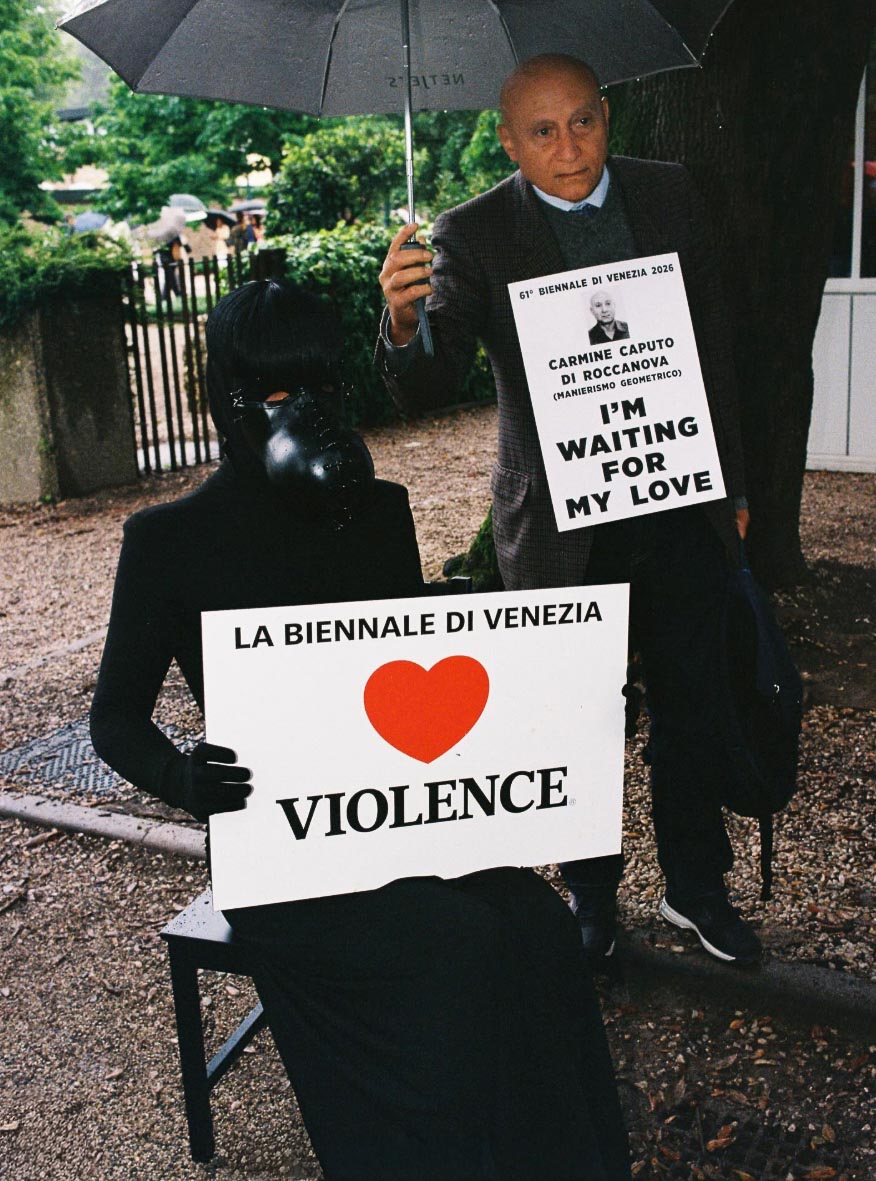
Georgian artist Shalva Nikvashvili often works with masks and explicit objects in his work, thematizing repression of the body and political violence. He came to Venice to protest against the reopening of the Russian pavilion. He refused official accreditation and financed the entire action through donations from the community on Instagram. With a banner “Venice loves Violence,” he silently sat on a provocative metal object with a sickle and hammer motif. Through this, he aimed to point out the ‘abuse’ of the institution, which allowed a state accused of war crimes to engage in artwashing and legitimize violence.
The project Echoes by Ukrainian artist Darya Koltsova, responds to Russian aggression by hanging authentic soldiers’ uniforms on laundry lines stretched between houses in Venetian streets. These belong to people from the cultural sector who were part of the art scene before the war but now serve actively, and therefore cannot participate in the biennale in person. These pieces of clothing, which have passed through hundreds of de-occupied territories, bring a tangible touch of ongoing war to the city. Among them are also uniforms of fighters from the Azov regiment, donated to the project by photographer and volunteer Tata Kepler.
In the series acts of resistance, one can include the stickers Death in Venice, scattered throughout the Giardini area. Behind this initiative is the Latvian representation, which is among the loudest critics of the biennale leadership. The slogan referencing Thomas Mann’s novella points to the moral decline of the institution that allows participation by states accused of war crimes and genocide.

Protest theatre of beauty
Although protest actions have been part of the biennale since 1968, many critics agree that this year’s edition is different in some way. This is indicated, for example, by the mass resignation of the international jury over disputes about political neutrality, police patrols in front of the temporarily open Russian pavilion, and the largest 24-hour strike in support of Artist Not Genocide Alliance (ANGA), during which up to 27 national pavilions fully or partially closed their doors. The institutional stability of the Venice contemporary art exhibition is unraveling in real time.
The most prominent controversy is the resignation of the jury composed of renowned curators such as Solange Oliveira Farkas, Zoe Butt, Elvira Dyangani Ose, Marta Kuzma, and Giovanna Zapperi. It happened just nine days before the opening of the exhibition. It was not an abrupt decision. The curators decided to resign following the statement issued on April 23, 2026, in which they announced their refusal to award prizes to countries whose leaders are under indictment by the International Criminal Court (ICC). Although they did not specify countries by name, it is clear that Russia and Israel are involved. Their representatives are subject to international arrest warrants related to ongoing wars. As a result, the biennale could not even maintain its own awards system under political pressure, and this year, instead of a professional jury, the lay public will decide the prestigious Golden Lion. This situation, including the circumstances of the jury’s resignation and subsequent reactions of the institution, is more thoroughly analyzed by Anežka Bartlová in her recent article for Artalk.
If we were to ask which pavilion attracted the most attention this year, it would probably be the Russian one. The surroundings of the historic villa of architect Alexei Shchusev in the Giardini area were guarded by crowds of Italian police officers and riot police. The pavilion reopened after a four-year break for only three days. It was accessible exclusively during the pre-opening for accredited journalists, politicians, and other selected figures from the art world. Currently, it remains closed to the public.
Several key protests took place here, shaping the media image of this year’s biennale. The most prominent was the massive protest by Pussy Riot and FEMEN, who occupied the building and temporarily forced its closure. Their protest continued outside the Giardini area in the streets of Venice, where over a hundred visitors joined them. Together, they moved to the main office of the biennale president, located in one of the palaces on the waterfront.
The current president of the institution, Pietrangelo Buttafuoco, appointed two years ago by the Italian right-wing government, advocates for depoliticizing the event and striving for some form of neutrality. In the context of the current situation, he stated that the biennale has no mandate to exclude states, as this decision is solely up to the countries themselves. While the gesture of artist Ruth Patil from 2024, who decided to voluntarily close the Israeli pavilion until a ceasefire is reached, is considered legitimate, external pressure from the ANGA campaign demanding a broad boycott of Israel is deemed unacceptable. Although the Israeli pavilion in Giardini remained closed this year under the pretext of “reconstruction,” the leadership allocated alternative spaces in the Arsenale to Israeli artist Belu-Simion Fainaru, further confirming their own hypocrisy.
Moreover, Buttafuoco faces additional controversial accusations. According to leaked email correspondence, published by Italian portals Open and La Repubblica, the return of the Russian representation was secretly coordinated since last summer. In communication with the curator of the Russian pavilion, Anastasia Karneeva, he discussed visa arrangements for the curatorial team and strategies to avoid losing a two-million-euro grant from the European Commission, which prohibits European institutions from collaborating with entities financed or controlled by Russia. The format of a three-day preview was intended to bypass these rules and prevent financial loss. Ultimately, the biennale still lost the grant. The opening of the Russian pavilion served solely political interests. During the event, a large amount of visual material was reportedly created, which Russians can use for propaganda purposes, claiming they are successfully resisting attempts at international isolation.

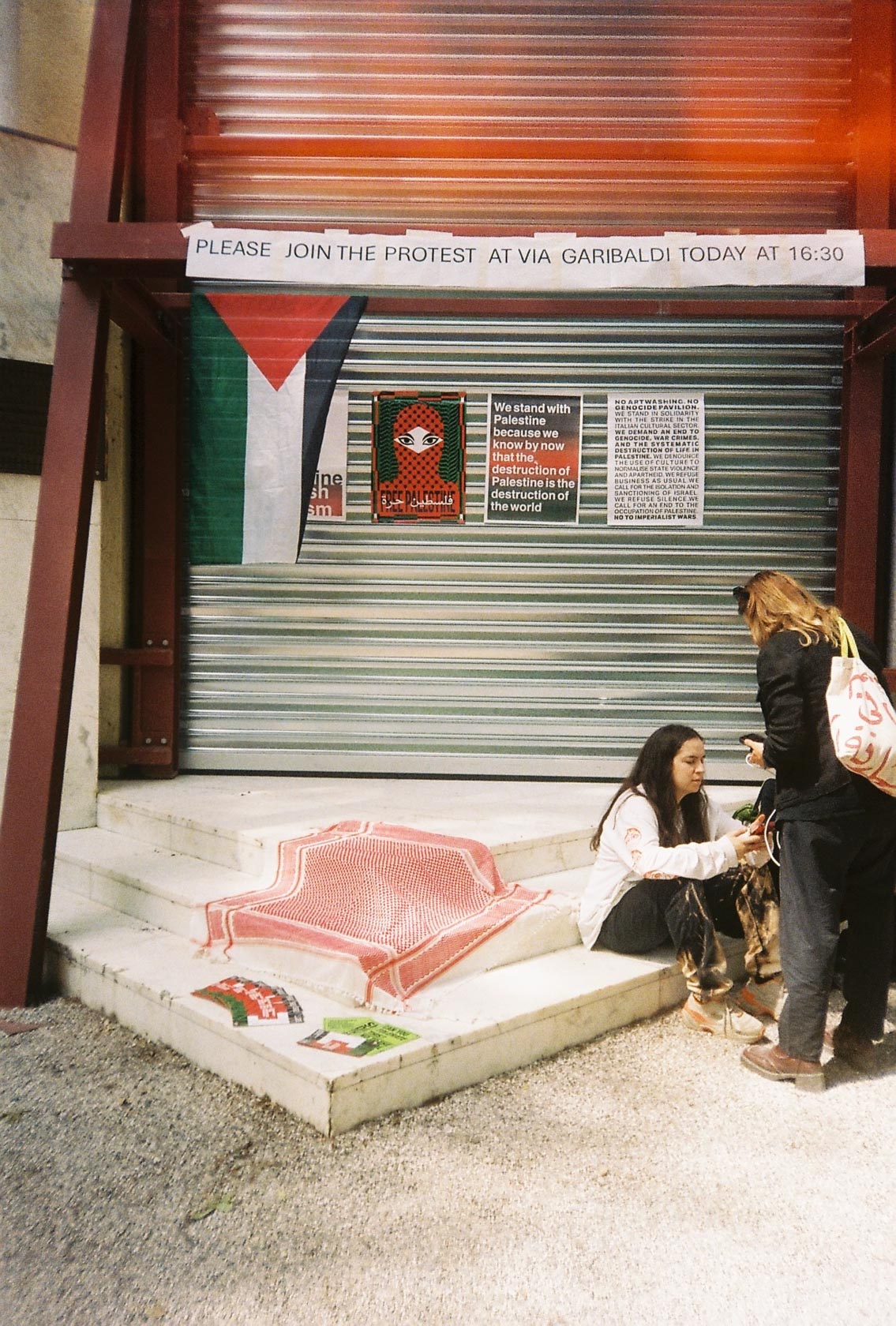
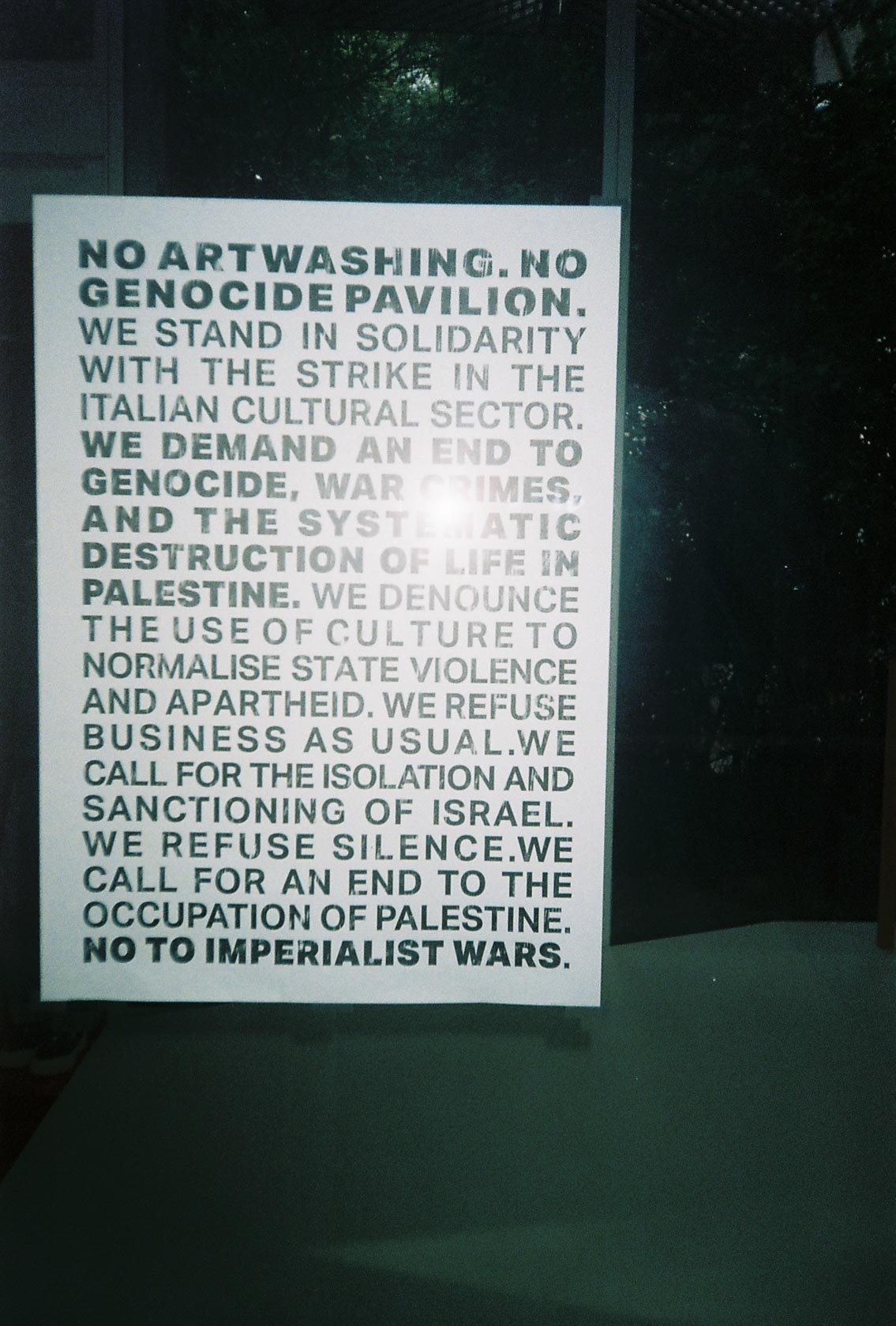
The last significant moment of the pre-opening days was a coordinated 24-hour strike that took place on May 8 under the banner of the ANGA alliance and Italian trade unions ADL Cobas, USB, and CUB. 27 out of 99 national pavilions, which fully or partially closed their doors in Giardini and Arsenale that day, participated in the action. The Czecho-Slovak presentation represented by Jakub Jansa, the duo Selmeci Kocka Jusko, and curator Peter Sita also joined. The protest visibly spilled over into the main exhibition In Minor Keys – many artists, as a sign of resistance, covered their works or incorporated Palestinian symbols into them. With this radical gesture, the artistic community clearly rejected the normalization of genocide and the institution’s complicity in war aggression. Undoubtedly, this is the largest coordinated protest of its kind since 1968.
Exhausted mole and Ukrainian feminists
The political charge of the biennale also fully spills into the interior of the national pavilions. The feminist dimension is presented by Florentina Holzinger (Austria) in the project Seaworld Venice, which responds to environmental collapse and civilizational exhaustion. Maja Malou Lyse (Denmark) in the project Things to Come examines masculinity, declining sperm counts, and the commodification of human reproduction in favor of capitalism. In the project Ruin, German artist with Vietnamese roots Sung Tieu transforms the fascist facade of the German pavilion through a mosaic of windows from an East Berlin panel building slated for demolition. The interior belongs to the recently deceased artist Henrike Naumann, who deconstructed the aesthetics of Nazi architecture through everyday objects. Luxembourg artist Aline Bouvy (Luxembourg) explores exhaustion politics and bodily norms in the project La Merde.
In the Czech-Slovak pavilion, which this year commemorates its 100th anniversary, Jakub Jansa, the duo Selmeci Kocka Jusko, and curator Peter Sita presented a joint project The Silence of the Mole. The main character of the story is Mr. M. – once a symbol of childhood innocence, now an empty figure of cultural production and a tired actor stuck in the role of a fairy tale Krteček. He was sent to Giardini as a diplomatically acceptable and politically harmless figure, who in reality embodies silence, uncertainty, and tension associated with rising nationalism and politicization of the local cultural environment. The project raises an important question: Can our imagination turn into a obedient mask in the service of the state? The authors emphasized this stance also in the statement during the vernissage. According to them, cultural institutions should not only function as showcases of national success but as spaces protecting free thought, so that art does not turn into harmless decoration. The institutional crisis in both countries is ultimately underscored by the fact that at the official opening of the Czechoslovak pavilion on May 7, the Czech Minister of Culture Oto Klempíř was absent, who refused to participate, and the Slovak Minister of Culture, Martina Šimkovičová, was also not present.
The poverty biennale
The opposite side of the exclusivity and prominence of this year’s exhibition is the reality that Polish curator Jacek Sosnowski calls The Poor’s Biennale. Behind the shiny surface lies an institution in a state of financial crisis: European funds are shrinking year by year, the exhibition is gradually losing strong American financial actors, and many national pavilions struggle with chronic underfunding. Sosnowski points out that many artists from national pavilions leave Venice immediately after the opening due to budget issues. They simply cannot afford to stay in the expensive city. Moreover, they are often paid “peanuts” for their efforts and over a year of work.
The model of national pavilions is thus in crisis, and the financial gap is beginning to be filled by private capital. For example, luxury fashion house Bvlgari entered the scene as an exclusive partner of the biennale until 2030, and this year opened its own corporate pavilion in Giardini. Thanks to unlimited financial resources, it can operate more freely and without bureaucratic restrictions. Does this trend indicate a gradual retreat of nation-states in favor of the corporate sphere?
The Venice biennale is often called an Olympics of art. However, Jacek Sosnowski ironically refers to it more as UN of art, which is also in very poor condition. Geopolitical fragmentation, the shift to popular voting for the Golden Lion, the loss of expertise and political weight… This year, Venice became a true mirror of global chaos. “Art must stop dealing with how it looks on the outside and take control of the economy of emotions. We are the ones who move hearts,” Sosnowski writes.

The text is part of the PERSPECTIVES project – a new brand for independent, constructive, and multiperspective journalism. The project is funded by the European Union. The expressed opinions and positions are those of the author(s) and do not necessarily reflect the views of the European Union or the European Education and Culture Executive Agency (EACEA). The European Union and EACEA do not accept any responsibility for them.