Searching for a language for what resists naming
Kapitál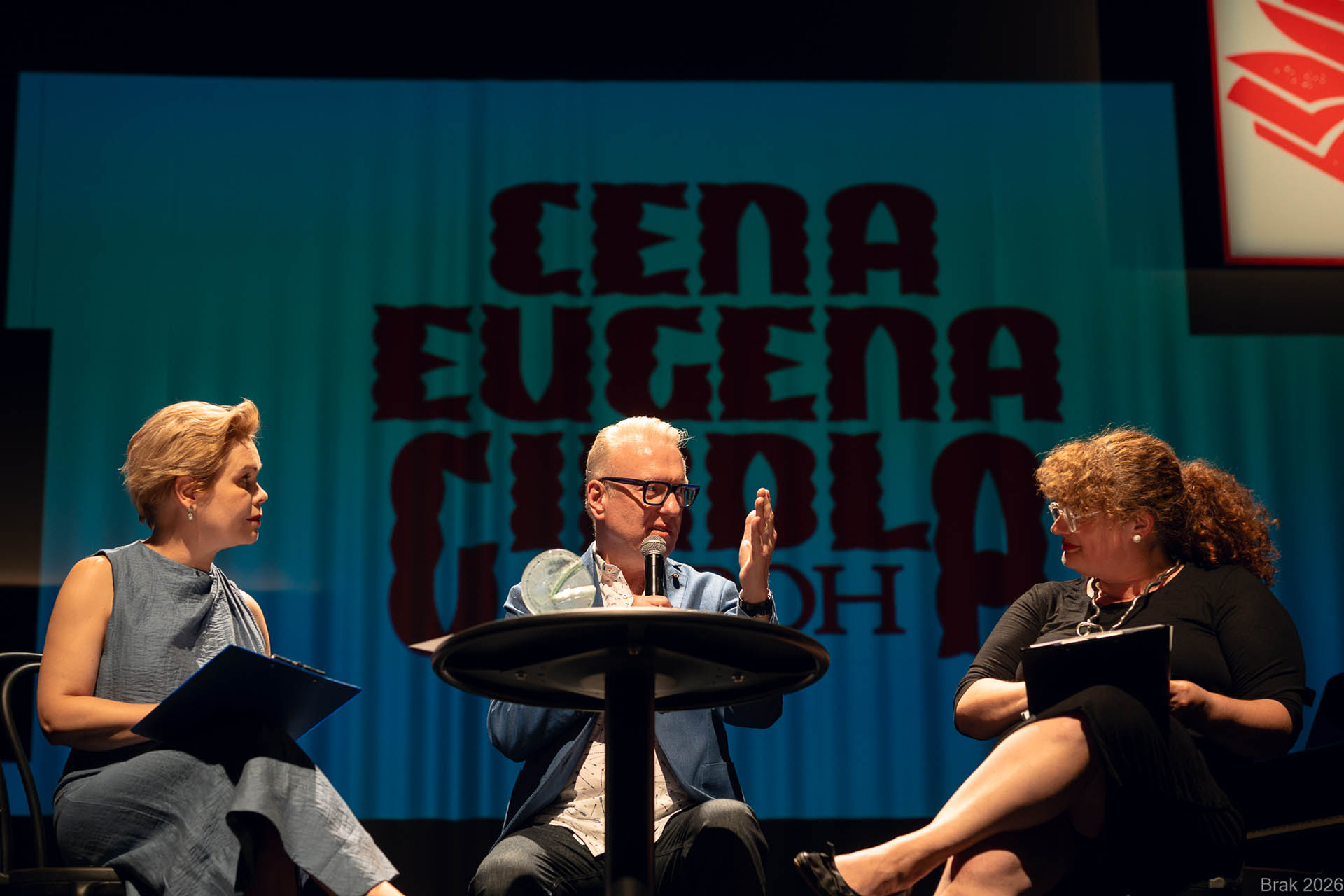
The BRaK Book Festival this year again opened with a ceremonial evening, combined with the awarding of the Eugene Gindl Prize. We present to you the laudation for the laureate, the icon of Polish reportage Mariusz Szczygieł, by Rafał Majerek, a member of the Eugene Gindl Prize jury and an assistant at the Department of Slavic Philology at the Institute of Slavic Philology at Jagiellonian University in Krakow.
The BRaK Book Festival once again opened with a ceremonial evening, combined with the awarding of the Eugene Gindl Prize. We present to you the laudation for the laureate, the icon of Polish reportage Mariusz Szczygieł, by Rafał Majerek, a member of the Eugene Gindl Prize jury and an assistant professor at the Department of Slavic Philology at the Institute of Slavic Studies at Jagiellonian University in Krakow.
Dear ladies and gentlemen, guests of today's event, good evening,
it is a great honor for me to present the reasons why the jury of the Eugene Gindl Prize decided to award it this year to Mariusz Szczygieł. I will limit myself to the most important ones.
The Eugene Gindl Prize is awarded to individuals whose work is characterized by a high artistic level, ethical sensitivity, and a strong sense of responsibility for the way reportage literature depicts reality. It is intended for authors whose texts significantly contribute to the development of the reportage tradition, creatively build upon it, and push it in new directions. These are works that combine precise observation with thoughtful composition and cultivated language, and which have the ability to leave a lasting imprint on cultural consciousness.
The work of Mariusz Szczygieł undoubtedly aligns with the spirit in which the Eugene Gindl Prize was founded. His books and reports combine a distinctive literary form with a deep interest in people and society. They show that reportage can be not only accurate in details but also artistically impressive. The author approaches the heroes and heroines of his reports with respect and empathy. He is able to sensitively capture fragile moments of human destinies and at the same time place them within a broader historical and social context.
Among the central themes associated inseparably with the name of Mariusz Szczygieł is Czech culture. Although he has dedicated several texts to it, I will mention at least two particularly inspiring books: Gottland and Zrób sobie raj (Make Yourself a Paradise). In them, the author offers a multi-layered view of Czech society with its rich and complicated past and present. He reveals lesser-known, often complex chapters of history, recalls forgotten figures and situations, and shows how Czech destinies are intertwined with traumas, paradoxes, and moral dilemmas. His sensitive interpretation of Czech culture also contributes to a deeper understanding of Central Europe as a unique space where historical experience, cultural memory, and geopolitical tensions intertwine. It is also worth emphasizing that thanks to translations of his books, this deeper perspective on Czech culture and history has not been limited to Poland but has also reached readers in other countries.
His view of Czech issues also reveals one of the fundamental features of the author's creative gesture. Szczygieł does not approach Czech culture merely as an interesting reportage topic – he openly loves it. It is for him a “love from heaven,” as suggested by the title of one of his books.
He also wishes to share this love, connected with a deep fascination, with readers. It is not only about conveying new knowledge or interpretations but also about passing on something personally important. His texts thus become a space for dialogue – an invitation to enter into a conversation with another culture and at the same time an opportunity to reflect more deeply on one's own.
Of course, in his writing, the story and its processing play an important role – reportage must maintain tension, surprise, and attract the reader. The story, in the case of our laureate, is always masterfully handled, but it is never an end in itself. It is only the first layer, behind which another space opens – it becomes an entry point to deeper reflection. Reflection on values, memory, the relationship of the individual to history and power, on how we live together with others. Thanks to this, his reports are read not only as engaging stories but also as stimuli for personal reflection.
Mariusz Szczygieł’s authorial style is characterized by a remarkable sense of composition and precise work with language. His texts transcend genre boundaries and often significantly reevaluate the very understanding of reportage. The author combines documentary accuracy with essayistic depth and subtle irony, creating a distinctive, easily recognizable handwriting. It is precisely in the ability to find new expressive possibilities and formal solutions that his significant contribution to contemporary literary reportage lies. These qualities are present throughout his work, but they are especially concentrated in the book Nie ma (There Is No). This work is primarily about seeking an adequate form to capture loss and absence, as well as reflection on transience. In the author's presentation, this process of searching for a language for what resists naming is extraordinarily suggestive and creatively convincing.
The exceptional nature of this work and the strength of its message are also evidenced by the way it was received. The book Nie ma received the most prestigious Polish literary award, the Nike Prize, awarded by an expert jury. At the same time, readers voted it as the best book of 2019. Such agreement between the jury and the reading public is quite rare and emphasizes the impact of this work. It should also be added that Mariusz Szczygieł belongs to authors whose work has been recognized with many significant literary awards at home and abroad – a complete list, however, would far exceed the scope of this speech.
Our laureate masters the craft of writing perfectly, but his interest in reportage goes beyond just writing literary reports. He also reflects on the essence of this literary form – what makes it unique, how to understand the concept of truth within reportage literature, and how to handle the material at the author's disposal. He pays great attention to the question of responsibility for words. These reflections and considerations are especially evident in the book Fakty muszą zatańczyć (Facts Must Dance), which testifies to his deep authorial consciousness and ethical sensitivity.
An important part of his authorial awareness is also a strong relationship with the reportage tradition, which he follows and creatively develops. Primarily, this is the tradition associated with the Polish school of reportage and its prominent figures. Among many, let’s mention at least Hanna Krall and Małgorzata Szejnert. It is also worth noting an older line of texts dating back to the early 20th century, which contributed to shaping reportage as a literary and journalistic genre. Respect for tradition, combined with efforts to make it present and systematically popularize it, ultimately culminated in an exceptional publishing project. This is the three-volume anthology of Polish reportage of the 20th century, edited by Mariusz Szczygieł – a project spanning nearly three thousand pages, representing a unique attempt to comprehensively map the development of this genre in the Polish context.
Similarly to the bringing to life of significant works of the past and cultivating memory, thinking about the future – about how reportage literature will continue to develop and what conditions this development requires – are fundamental aspects of Mariusz Szczygieł’s activity. This is also clearly reflected in his institutional activities. He is a co-founder of the Reportage Institute Foundation (together with Wojciech Tochman and Pawło Goźliński), within which, among other things, a publishing house Dowody na istnienie (Proofs of Existence) and a reportage school were established. These significantly contribute to shaping a new generation of reportage authors.
Dear Mr. Szczygieł,
The jury of the Eugene Gindl Prize has decided to award you this honor as a recognition of your exceptional literary work. The originality of your writing, masterful use of language, deep immersion into human stories, and the ability to capture what remains hidden, ambiguous, or difficult to articulate, are a significant enrichment of contemporary reportage literature. We also appreciate that through your work, you long-term expand the space where reportage is created and develops – as an author, editor, and initiator of projects supporting its further evolution.
Allow me, on behalf of the jury, to sincerely congratulate you on receiving the Eugene Gindl Prize for the year 2026.